
Space Combat in Mörk Sol
A deep dive into what makes Mörk Sol's skip combat system tick, how you can run it, and what accessories might make your life easier.

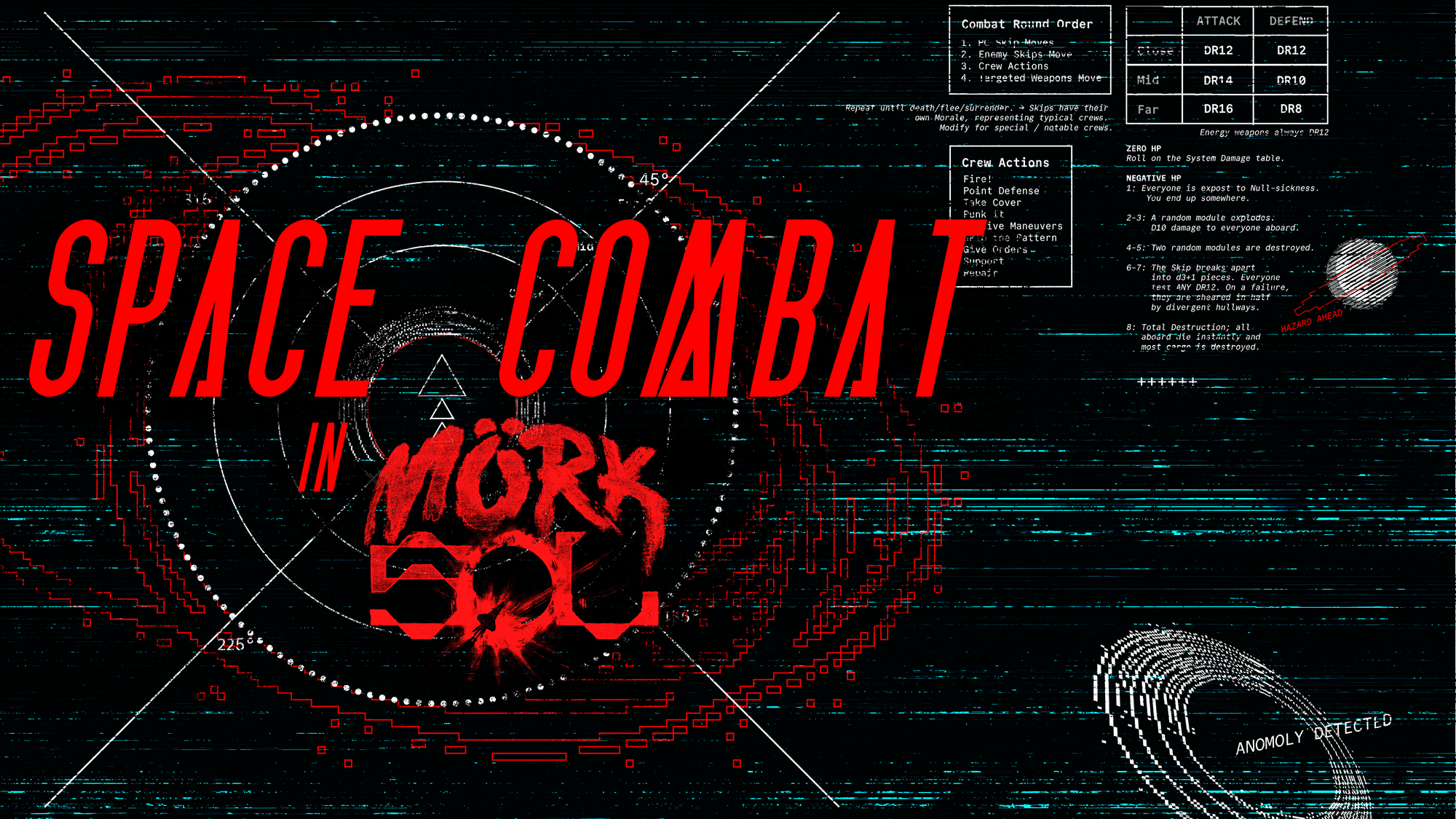
How to Flip & Burn!
A deep-dive into Mörk Sol's skip combat (and the tools of the trade).
When we set out to create Mörk Sol, space combat was at the front of our minds. We knew we wanted to capture the same fast, fun, explosive feeling we experienced in CY_BORG combat, but with spaceships. We wanted there to be tactical choices, but not so complex that it would bog things down. And finally, perhaps most importantly, we wanted combat to flow seamlessly between individuals and ships.
Ideally, if we did it right, a single round of ship combat could involve...
... your Gunner blasting a space pirate skip out of the sky
... your Engineer frantically repairing damage to your hull
... your Security Officer fending off a xeno infestation in the cargo hold
... a last-second diversion of power from shields to thrusters by your Operator
and your Pilot punches the engine, ripping past the enemies surrounding your skip!
And after playtesting the most recent version of Skip Combat, we think we've nailed it! Mörk Sol now allows individual and ship combat to happen seamlessly and simultaneously, without complicated tools or maps.
With our Kickstarter surpassing 500% funding and unlocking several add-ons focused on Skip Combat, we thought it was a great time to dive into the Skip Combat system and the design process that forged it.
We knew what We Didn't want
Our design process was heavily inspired by the numerous iterations on ship vs ship combat we've played in other TTRPGs; both what we loved about them, and what we didn't love.
1-Hex Maps
No squares either, but we specifically call out hex maps/grids because they are so common in the world of ship combat, be it space or nautical. That's not to say these are bad. We just felt like the use of hex grids leads to two things we didn't want: a lack of 3-dimensionality in space combat; and the crunchiness of specifying turning radius and other movement speed fiddly bits. The first would diminish the "space cowboy", Firefly, Expanse, flip-and-burn feeling we wanted to achieve, and the second would crank up the crunch factor way too high.
2-Phases
Very often, space combat gets portioned out into Phases, more like the wargames that TTRPGs sprang from. The Movement Phase. The Command Phase. The Weapons Phase. Again, these things aren't inherently bad, but we knew that we wanted to avoid them because of the feeling they create. It makes ship combat feel like a mini-game, not The Game. We want ship combat to be something that feels like a natural extension of "normal", on-foot, PC focused combat. And that can't happen if it has an entirely different action economy.
Note: Some might remember that very early playtest versions of Mörk Sol's skip combat used phases. The deeper into playtesting we got, the more we refined the rules into the phase-less system we now have. Minimizing the use of phases was always a goal, but it took some at-the-table experience to see what really worked.
3-Different Damage Scales
This is the idea that ships are so big and destructive compared to human-sized weapons that you need a totally different way to track damage. Mothership uses Megadamage, for example. This is another mechanic that increases verisimilitude, but also further isolates ship combat from individual combat. And the greater that distance, the more that ship combat will feel like a mini-game. We also wanted to facilitate the desperate, awesome moment where your skip runs out of ammo and a crew member leaves the safety of the hull to fire hand-held weaponry at the enemy ship(s). That's a cool moment! But it can't happen, or at least becomes harder, if there are two types of damage.
Defining our design space (pun intended)
With our end-goals firmly set and an understanding of what we knew wouldn't get us there, we set out to create our ideal ship combat system. This is what we came up with!
Instead of Hex Maps ➞ Relative Movement
Instead of Phases ➞ Crew Actions in normal initiative
Instead of Different Damage Scales ➞ Tactical Weapon Typing
Note: if you just want to see our solution in action, you can skip ahead to see an Example of Play walk-through.

Relative Movement Map
This is where the solution started, and it's been the firm foundation of our skip combat system throughout its development. "How do skips move around in combat" is a fundamental question to answer since every other mechanic - your action economy, attack & defense resolution - flows from there. It needed to be quick, have a low barrier to entry (i.e. no 3D software, so moving in 3-dimensions needed to be abstracted), and fun.
Conlin's solution was incredibly elegant: the only distance that matters in space combat is how far away your ship is from the things trying to kill it.
@infinite_citadel Have you given our ship combat rules a try yet? If not, take a look. @hasbeenwizard walks us through the simplicity of setup and How to Draw a Battle Map for Ship Combat in Mörk Sol. #mörkborg #mörksol #ttrpgcommunity
♬ original sound - InfiniteCitadel
Conlin explaining how simple it is to draw a battle map in Mörk Sol
At the center of this map is where the PC's skip is in space. Four quadrants radiate outward from that point, each with three arcs representing the ranges Close, Mid, and Far. The circle around the skip is considered Adjacent (think "danger close" in space, considering you probably don't want to be bumping into anything). During combat, all movement and ranges are relative to the location of the party's skip.
While we love how this map looks in our premium assets, like the Skip HUD Poster and the foldable Skip Combat Map, it's just as usable with a quick sketch on paper!

Note: We will be creating digital assets for free personal use similar to the graphics on our physical components. Those (and the other print-at-home assets) will be on the Mörk Sol Itch page.
You can also use online tools like Excalidraw to make & manipulate the map, which has been our go-to for easy setup & teardown during our online Mörk Sol games.

Whenever your skip moves, it stays in place on the map and everything else moves around your skip. You choose a quadrant to move towards and anything in front of you (i.e. in the quadrant you're moving towards) gets closer. Everything behind you moves further away, and everything to the sides of you moves to be behind you, but at the same distance.
That sounds really complicated, but its one of those things where after you do it, the words fall away and it just makes sense. Hopefully you get that experience in the walk-through below, which includes screenshots from Exalidraw to help illustrate everything going on.
This relative-positioning thought also inspired the Vehicular system we created for chase sequences and vehicle combat in CY_BORG. Once we had playtested and were confident the idea worked for 2D interactions (with a bit of 3D for submarine & flying vehicles), we knew we had something that would perform well for Mörk Sol.

You can play with the full Vehicular rules - and plenty more additional content for CY_BORG - by picking up a copy of Temperamental Upgrades available right now on our Itch.io or in the Infinite Citadel Store.
Crew Actions
With positioning and ranges sorted, now we needed to solve the action economy. This would prove to be the trickiest part of our ship combat, and thus the part that has change a lot over the past two years. But thanks to the amazing folks on our Discord, our actual play partners at Tales of Initiative, and the folks who came out to play our games at GenCon, we've reached a spot that has achieved all of our goals.
Everything in skip combat happens as the result of a Crew Action. This makes the action economy and initiative system exactly the same as when you're in combat as an individual Skav. If you've never played a Borg before, here's the basic flow...
- Roll a d6 to determine who goes first. 1-3: Enemies. 4-6: PCs.
- When a side (enemies or PCs) goes, they take their turns in any order they wish. PCs roll for both their own attacks and for defending against any attacks the enemies inflict on them.
And that's it! Extremely simple and fast, which is what we love about it. It's why we worked so hard to distill skip combat into something that could fit inside that basic flow... and it does!
You roll for initiative exactly the same way and then each crew member takes their turn. The things they can do are anything they could do normally (fire a skav-sized weapon, use equipment, invoke Nullmarks, etc.), or they can use a Crew Action. The only difference between a normal action and a crew action in Mörk Sol is that crew actions always involve your skip.
This is where skip combat gets a little more complex than skav combat. Each round, each PC decides which Position they want to be in. Positions are limited to one skav at a time, and they determine what crew actions are available to them. For example, you can't Fire! a weapon unless you're in a Gunner Position. If you want to move your skip, the skav in the Helm Position will need to use a crew action that allows the skip to move.
Some crew actions - like Repair and Support - can be used from any position. Some crew actions - like Skip the Pattern - can be used from multiple positions (Helm or Bridge, for example).
This is where things like our Skip Positions Pad come in. While it's not at all necessary, it can help folks visually picture where the different skavs are in combat. It also includes helpful reminders of which crew actions are available in the default positions. There are even blank positions and extra slots for more crew actions; great for when you get new modules or upgrades that provide additional positions/actions!

For enemies, we don't want GMs to need to keep track of exactly which crew are on a given enemy skip. Instead, enemy skips include several Crew Actions they can perform on a turn. They have access to the default Helm, Gunner, and Any position actions, along with the specific actions & weapons that are contained in their stats. For example...
Pirate Skip
Roaming and ready for a fight. Disorganized. Cut-throat.
Hull Points 1d10+15 | Morale 6 | No Shields
Speed 2 | Crew Actions per turn: 1
Has one installed weapon from…
Flak Cannon: Kinetic, 2d6 damage
Anti-Skip Laz: Energy, 2d3 damage; shields are half effective (min 0)
Hunter Killer: Targeted, 3d6 damage, speed 2
Broadside: Move half speed and fire one weapon.
So while a Pirate Skip could use its single crew action to Fire! or Fly Casually, it's likely going to be using the Broadside crew action, allowing it to move and shoot in a single turn. Of course if it fails its morale check, it could always Punch It ➲ instead (and hope the PCs don't chase before it can Skip the Pattern).
Tactical Weapon Typing
The final piece of the puzzle for getting the tactics right was skip weaponry. This needed to answer our "Big Damage" problem, remain easy to use, but also provide a meaningful reason for the map's different ranges and quadrants to exist. I.e. movement needed to matter, otherwise the Helm would be boring and folks would just sit still and shoot.
So we added a little bit of tactical crunch to the types of weapons skips can use.
Skip weaponry comes in three types:
- Kinetic weapons are the pinnacle of rock-throwing technology. They use force to propel physical projectiles - bullets, shrapnel, etc. - towards their target.
- Targeted weapons are self-propelled weapons that have smarts of their own. These are missiles, torpedoes, and other delayed-arrival munitions.
- Energy weapons fire concentrated bursts of fast-as-light energy at their targets.
There is also a Special category to represent those weapons that behave outside these three groups. Each special weapon defines its own rules in full.
Each of these types has a different role to play in skip combat. Think of it a little like paper-rock-scissors. The weapons you have impact how best to move and fight with your skip.
Kinetic weapons deal the most average damage. There's nothing special about them; however, that means they can be the most flexible. They are also capable of Point Defense; rather than trying to dodge the target-lock of a targeted weapon, you can shoot it out of the sky with kinetic weaponry before it can reach you.
Targeted weapons trade speed for power. Your attack roll with a targeted weapon represents your skip achieving a target lock on your enemy and forwarding that data to the weapon. From there it launches into space and begins hunting down its target regardless of where they go. While it can be thrown off by cover or shot down by kinetic weapons, they deliver the biggest punch. Whereas kinetic weapons typically roll 2 dice for damage, targeted typically roll 3!
Energy weapons are a low-damage, high-consistency option. They usually roll smaller dice for damage, but because they are speed-of-light weapons, they ignore the range penalties that kinetic and targeted weapons have to deal with.
Range penalties?
Yes, this is part of making movement matter in skip combat. Attacks made against targets that are closer to you are easier, while defense tests are harder.

So if you stay away from your enemies, you're more likely to stay safe with those easy DR8 defense tests. But that means you're also shooting against DR16, so less likely to hit. Balancing the timing of Helm and Gunner actions could make the difference in a tight battle. It also means energy weapons, despite their smaller damage totals, have an important niche in skip combat.
Which circles back to our "Big Damage" problem. Our solution was to amp up the dice that skip weaponry uses while also boosting the average amount of Hull Points (hit points, but for skips). We want skip combat to feel deadly, but not guaranteed death like other OSR sci-fi games.
This also means that the damage any weapon does in the game is operating on the same scale. This makes sense when you consider that most weapons a skav is carrying probably started out as engineering equipment. Those weapons which are more tool than weapon will have traits that boost their damage against skips & objects to compensate for smaller dice. Of course your d8 Magrevolver isn't going to look like much compared to the 2d8 of a skip's MK1 Turret, or the 3d8 of a basic Torpedo.
Example Combat Walk-Through
With all the rules out of the way, let's see it all in action!
The crew of the Helix Drift has just skipped the Pattern en route to a handoff with their contact. The cargo on board will easily pay for some key upgrades, but it seems their ambitions have captured the attention of three pirate skips! (orange diamonds)

The GM rolls a d6... it's a 6! The PCs are going first.
Several asteroids (gray squares) are nearby, which might be able to provide some cover. But they could just as easily turn into a hazardous collision if the pilot isn't careful. Xori, the pilot skav, asks for help from Muse, their operator, who reroutes reactor power to the thrusters and makes sure the maneuvering engines are primed.
The operator is performing the Give Orders crew action. This is specific to the Bridge position and allows the skav in that position to assign d4's from their Bridge Pool to different positions on the skip. Since this is a basic skip and the Bridge's Module Grade is only I, they only have 1d4 to assign. Muse assigns it to the Helm Position, which means that Xori has a better shot of protecting their skip with the Take Cover crew action.
Take Cover
Position: Helm
Move your Skip up to its speed, then test Agility DR12 to use a piece of space debris within Close range as cover. Move the debris into Adjacent on success and gain -2DR on Defense Tests until the start of your next turn. Increase to -4DR for large cover (GM discretion).
First they move the skip up to its speed. Because their Helm Module is Grade I, they can move 1 zone. Of course really this means everything else will move 1 zone relative to the PC's skip. Starting in the quadrant they are moving away from...

The asteroid that was in 3-Close moves to 3-Mid. The pirate skip that was in 3-Far doesn't move; nothing can be further away than "far" in skip combat.
Now we move everything in the quadrant the skip is moving towards.

Two of the asteroids in quadrant 1 are already Close, so when they move closer to the PC skip, they instead go behind it to 3-Close. The other two objects - the pirate skip and the third asteroid - move one step closer to 1-Mid and 1-Close respectively.
Finally the objects in the two side quadrants are moved back towards quadrant 3, staying at the same range (i.e. distance away from the PC skip).

Now it's time to see if Xori can safely pilot the skip into an advantageous position among the asteroid field. They get to choose any asteroid in close range, and so opt for the one in 3-Close. It's bigger, meaning it will grant a bigger bonus if they can pass the test (but might cause more damage if they don't).
They roll a 7 on the dice, and +3 Agility means they only got a 10. But they still have the d4 from Give Orders. They roll a 2, which hits the DR exactly! Now that asteroid moves into Adjacent with the PC skip, and they'll have -4DR on all their defense tests until Xori's next turn.

Finally their gunner, El, uses the Fire! crew action to open fire on the pirate skip in 1-Mid. Their MK1 Turrent is a kinetic weapon, so the attack needs to hit DR14 to succeed. It's a 12 on the dice, and El's +3 Spine makes it a 15 total - a hit! She rolls 2d8 and deals 12 total damage; a massive hit against the pirate skip's 16 Hull Points.
But now it's the pirates' turns! Skip A has an Anti-Skip Laz weapon, which gives it the advantage of energy weapons. It uses the Broadside crew action to retaliate while still protecting itself, moving half speed (2 zones ➞ 1 zone) back to 1-Far and firing the weapon.
Xori is at the Helm, so they roll all of the skip's defense tests. These tests normally don't have any modifiers, which is why doing things like gaining cover can be such a big deal. Xori rolls a 10, which would normally fail. But because of the -4DR, it changes the energy weapon's far-range DR of 12 down to an 8, so no damage!

Pirate Skip C has a Flak Cannon and wants to get closer, but can't get far enough with Broadside for a clean shot. It uses the same Take Cover action that Xori did, moving up to 3-Mid and then to 3-Close. The GM rolls a d20 with no modifiers to try and take cover against one of the asteroids in 3-Close, but rolls an 11. That's not enough to gain cover, but it's not a fumble, so they don't take damage.
B chooses to be aggressive and uses Broadside to move from 3-Far to 2-Far, attempting to get a target lock on the PC's with its Hunter Killer. Xori rolls to defend, but it's a 3! Even with -4 DR dropping the test from DR8 down to DR4, that's not enough. The hunter killer is locked on, and the weapon is added to the map in the same zone as the skip that fired it.

Now that all of the skips - PCs and enemies - have taken their turns, any targeted weapons on the map get to move. Unfortunately for the crew of the Helix Drift, that's currently a pirate hunter killer!

Targeted weapons move exactly the same way as enemy skips: each step of movement must be either between adjacent ranges in the same quadrant, or between adjacent quadrants in the same range. The hunter killer has a speed of 2, so it moves from 2-Far to 2-Mid, and then to 2-Close. If a targeted weapon shares a zone with its target at any point in its movement, it detonates and deals damage.
Fortunately for the PCs, it didn't get close enough to detonate; it would need to move into Adjacent.
Unfortunately for the PCs, they are watching a hunter killer missile that can do 3d6 damage get closer and closer to their skip. Unless they go full burn and leave themselves open to counter attack, it will reach them in one round. Or maybe El can shoot it with her turret! But that means they aren't shooting at the pirates, who are eager to see the Helix Drift turned to profitable scrap.
What would you do?
We hope you enjoyed this deep dive into Mörk Sol's skip combat. We barely scratched the surface in our example. Those pirates could instead try to get close and send a boarding party jetpack-ing through space. Or maybe one of the PCs has a Nullmark that could change the tide of battle. The opportunities for epic space combat are endless!
If you want to try the game yourself, go check out the Mörk Sol Itch page where we have the playtest rules and print-at-home Skav & Skip sheets. Or if you really like what you've seen here, go back it on Kickstarter.